In this entry, you’ll learn what frameworks are in critical thinking.
Frameworks are very handy tools for breaking down the question. It’s no exaggeration to say that critical thinking is impossible without them. Make sure you understand them well.
This entry doesn’t explain “breaking down the question” in detail. If the term doesn’t click, start reading from the link below.

Let’s begin.
toc
What Is a Framework?
Let’s clarify what the word “framework” means. You hear it everywhere. But what does it mean?
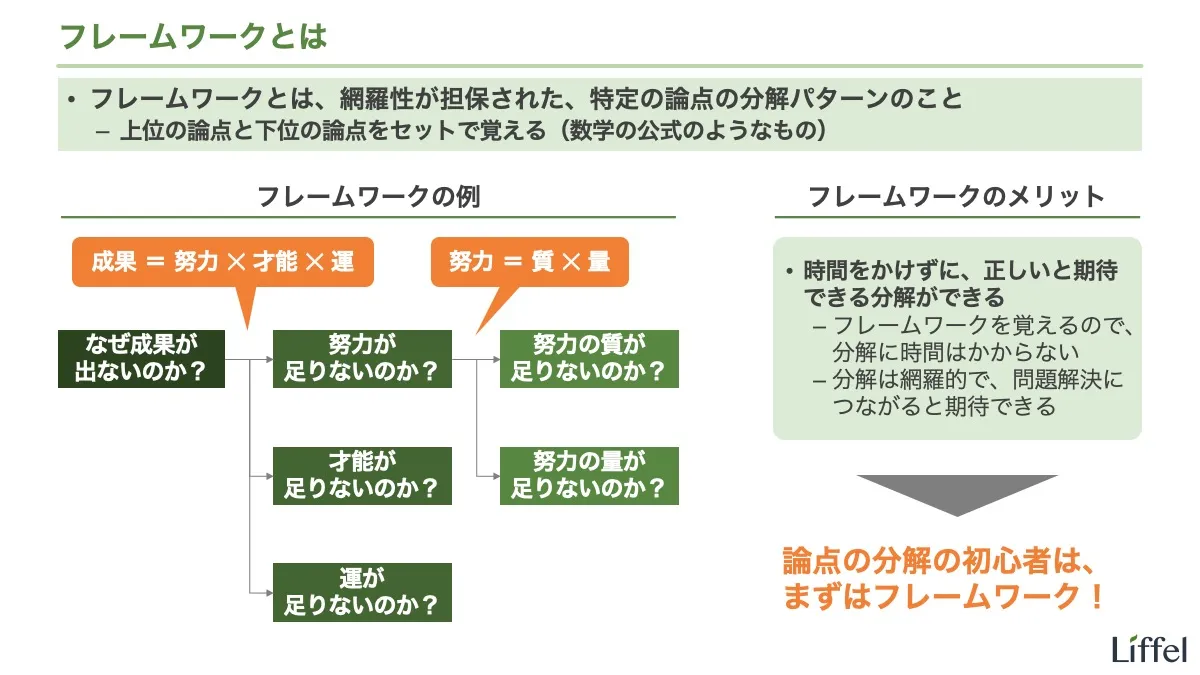
To give the conclusion first, a framework is “a specific breakdown of a question that is established to be exhaustive (MECE).” In other words, a framework is a set consisting of a main question (higher-level question) and the sub-questions (lower-level questions) it’s broken down into, and the breakdown is exhaustive. Think of it like a math formula.
Framework: a specific breakdown of a question that is established to be exhaustive (MECE)
Note, however, that this definition is specific to this site. Currently, “framework” means different things to different people. Keep in mind that everything that follows applies only when “framework” is defined as above.
Examples of Frameworks
Let’s look at frameworks through concrete examples. Take a look at the slide below.
This slide breaks down a question using two frameworks: “Results = Effort × Talent × Luck” and “Effort = Quality × Quantity.”
First, if you’re not getting results as an individual in a particular field, you can break the problem down into effort, talent, and luck.
Results = Effort × Talent × Luck
Actually breaking down the question gives you the following:
- Why am I not getting results in XX?
- Am I putting in enough effort?
- Do I have enough talent?
- Do I have enough luck?
The indentation of the bullet points shows the relationship between the main question and the sub-questions. Confirm that answering the three sub-questions seems to let you answer the main question (= there are no factors for individual success in a field other than effort, talent, and luck).
Note that for clarity, I express the frameworks themselves as “combinations of nouns,” but what essentially matters is being able to build a question (interrogative sentence) structure. As mentioned, frameworks are used to break down questions. Be careful not to memorize only the catchy nouns and then find yourself unable to break down a question when it counts.
Let’s look at the next framework too. Effort can be broken down into “quality of effort (how you make the effort)” and “quantity of effort (pure time invested).” This breakdown is also exhaustive.
Effort = Quality (how you make the effort) × Quantity (time invested)
Using this framework too, you can develop the earlier question structure further.
- Why am I not getting results in XX?
- Am I putting in enough effort?
- Is the quality of my effort sufficient? (= Am I making the effort the right way?)
- Is the quantity of my effort sufficient? (= Am I putting in enough time?)
- Do I have enough talent?
- Do I have enough luck?
- Am I putting in enough effort?
In this way, you memorize “how to break down a question when you encounter it,” and when you face that question, you break it down as if applying a math formula. That’s what it means to use a framework.
Exercise
Practice makes perfect, so try using the frameworks above.
Break down the following main questions using the frameworks. Adjust the wording to fit each main question.
- Why aren’t my grades improving?
- Why can’t I make the starting lineup on my (basketball) team?
- Why isn’t my diet working?
Since the goal this time is to get used to frameworks, apply the frameworks above mechanically. You may have some reservations. I’ll address them later.
- Why aren’t my grades improving?
- Am I studying enough?
- Am I studying the right way?
- Am I studying for enough time?
- Do I have enough talent (raw intelligence / innate intellectual ability)?
- Do I have enough luck?
- Am I studying enough?
- Why can’t I make the starting lineup on my (basketball) team?
- Am I practicing enough?
- Am I practicing the right way?
- Am I practicing for enough time?
- Do I have enough talent (athletic ability)?
- Do I have enough luck?
- Am I practicing enough?
- Why isn’t my diet working?
- Am I making enough effort?
- Am I dieting the right way?
- Am I sticking with the right method over the long term?
- Do I have enough talent?
- Do I have enough luck?
- Am I making enough effort?
Note: For dieting, expressing “quantity of effort” as absolute time doesn’t feel right, so I’ve changed it to an expression meaning “continuing the effort.”
The Advantages of Frameworks
What are the advantages of using frameworks to break down the question?
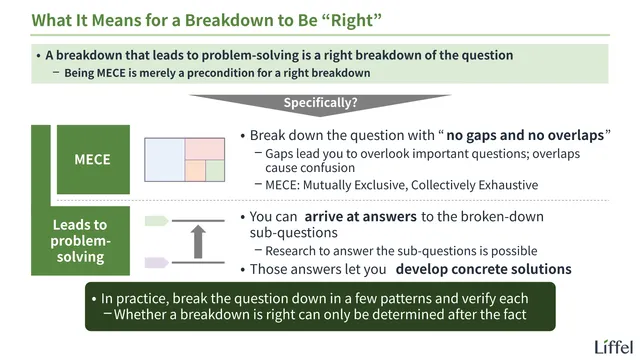
It’s that you can make right breakdowns without spending time.
First, using a framework takes no time, because frameworks are something you memorize. If you’ve memorized the Pythagorean theorem, you can calculate the sides of a right triangle the moment you see one. In the same way, if you’ve stockpiled frameworks, you can break down a question the moment you see it.
And you can expect breakdowns made with frameworks to be right (= to lead to problem solving). There are two reasons for this.
First, by definition, the breakdown will be exhaustive. An exhaustive breakdown is a prerequisite for a right breakdown. It’s a relief to be able to break down a question without worrying about gaps or overlaps.
Second, in the long run, frameworks that are merely exhaustive but don’t help solve problems fall out of use. So you can expect surviving frameworks to be reasonably useful.
However, since there’s no “useful framework certification committee” anywhere, you also see a fair number of useless frameworks stubbornly surviving. I’ll talk about that in the next entry.
With frameworks, you can make breakdowns that you can expect to be right, without spending time
What Should You Do If You Want Results?
If you can expect breakdowns made with frameworks to be right, they should lead to problem solving. Let’s check this with the frameworks introduced earlier, “Results = Effort × Talent × Luck” and “Effort = Quality × Quantity.”
First, from the framework “Results = Effort × Talent × Luck,” you can read that “if you want results, all you can do is make an effort.” That’s because there’s no solution in this world for improving talent or luck (it’s hard even to verify whether you have them in the first place). Of these three elements, effort is the only one for which you can come up with concrete solutions.
That much is obvious, but this framework also tells you the brutal truth that “if you don’t get results even with tremendous effort, you have to give up.” Again, that’s because there’s no solution for talent and luck. In other words, “you should make an effort in fields where you have talent.” With this framework, you won’t fall into the cult of effort and waste effort.
And when we say “effort,” we tend to think only of the quantity of effort, because that’s what’s easiest to control. This is why we easily fall into the “try hard enough and it’ll work out” mindset of sheer grit.
But with the framework “Effort = Quality × Quantity,” you won’t forget that effort has another aspect: “quality.” Trying hard matters, but thinking about how to try matters just as much. Given that time is limited, improving quality may be even more important (provided that quantity exceeds a certain level).
No one would object to these messages (the bold parts) derived from the two frameworks. That shows these frameworks lead to problem solving.
In this way, the advantages of using frameworks are great. If you’ve never broken down a question before, I recommend starting by memorizing the main frameworks.
If you break down questions many times using frameworks, you’ll understand through experience what it means, and why it helps, to break down the question the right way. Once you’ve got that feel, you can try breaking down questions on your own without relying on frameworks.
Until you get used to breaking down questions, it’s best to use frameworks
Cautions About Frameworks
Next, let me explain some cautions about using frameworks. Although frameworks are handy, they’re not all-powerful. Use them properly with an understanding of their limits.
There are three main cautions:
- Frameworks aren’t necessarily exhaustive
- Frameworks don’t tell you how much each sub-question weighs
- Frameworks alone can’t take you deep enough
Let me explain each in turn.
Caution 1: Frameworks Aren’t Necessarily Exhaustive
First, breakdowns made with frameworks aren’t 100 percent guaranteed to be exhaustive.
Earlier, I defined a framework as “a specific breakdown of a question that is established to be exhaustive (MECE).” But that’s a bit of an exaggeration. It only means “generally considered to be exhaustive.”
What counts as “exhaustive” is decided subjectively. Even a framework you think is exhaustive may not be accepted as such by others.
For example, I introduced the framework “Results = Effort × Talent × Luck” earlier. But some people take the view that “the ability to make an effort is itself a talent.” In that case, it becomes “Results = Talent × Luck,” and the framework changes.
Which to adopt is decided subjectively. Personally, since I find a worldview in which everything is decided by talent and luck hard to accept, I prefer “Results = Effort × Talent × Luck.” But as the words “hard to accept” and “prefer” show, that’s only my subjective judgment.
This applies to many frameworks. Except for frameworks that break things down mathematically1, you can’t know whether a framework is completely exhaustive.
This means when you use a new framework, always check it yourself. Check for yourself whether the framework is exhaustive and whether it helps solve problems.
When you use frameworks to persuade people, as in presentations, you need to be even more careful. There’s no telling whether your audience will accept the framework you use. Be ready to explain in your own words why the framework is right. It’s insurance in case you’re challenged.
Always check for yourself whether a framework is usable
Caution 2: Frameworks Don’t Tell You How Much Each Sub-Question Weighs
Second, frameworks don’t tell you how much each sub-question weighs. “Weight” here means how likely it is that examining that sub-question will lead to solving the problem.
In real critical thinking, you often aim to solve problems quickly by identifying the heavily weighted sub-questions and concentrating your resources on them. But frameworks don’t give you that perspective.
As an example, let’s look at the diet breakdown from earlier.
- Why isn’t my diet working?
- Am I making enough effort?
- Am I dieting the right way?
- Am I sticking with the right method over the long term?
- Do I have enough talent?
- Do I have enough luck?
- Am I making enough effort?
Of these, there’s no point in examining the sub-questions about talent and luck. It’s hard to imagine talent or luck playing a role in dieting.
First, talent. There’s no debate that talent plays an important role in studying and sports. But what about dieting? Strictly speaking, since no two people have exactly the same “innate ability to lose weight (whether their body type makes it easy to lose weight),” talent has some effect. But considering that people in a state of starvation are without exception thin, it’s safe to assume that everyone has the “talent to lose weight,” that is, that talent doesn’t greatly affect the outcome2.
The same goes for luck. For themes where you repeat attempts many times over a long period, the effect of luck can be ignored, because you can’t be lucky or unlucky all the time. In that sense, you can ignore luck in all the exercise topics this time: studying, sports, and dieting3.
In other words, for dieting, the sub-questions about talent and luck weigh almost nothing. So organizing the question with weight in mind, as follows, leads better to problem solving (= a successful diet):
- Why isn’t my diet working?
- Am I dieting the right way?
- Am I sticking with the right method over the long term?
In this way, since frameworks only give you mechanical breakdowns, you need to think for yourself about which sub-questions to focus on. If, after breaking down a question with a framework, some sub-questions seem pointless to examine, you can make the call to cut them outright4.
You need to think for yourself about which sub-questions from a framework breakdown to focus on
However, you can only organize things like this well if you have prior knowledge. I can organize the question above because I know about dieting. When tackling a question you know nothing about, just follow the framework for now. Safety first.
Caution 3: Frameworks Alone Can’t Take You Deep Enough
Third, in many cases, frameworks alone can’t take you deep enough. “Can’t take you deep enough” means “can’t get you down to sub-questions small enough to verify and come up with concrete solutions for.”
Let me continue with the diet breakdown.
- Why isn’t my diet working?
- Am I dieting the right way?
- Am I sticking with the right method over the long term?
As it stands, this breakdown is too rough. For example, it’s unclear what “dieting the right way” concretely means. Unless you break the question down further, you can neither verify the questions nor come up with solutions.
Here, as an example, I broke it down as follows:
- Why isn’t my diet working?
- Am I dieting the right way?
- Diet: When, what, and how much am I eating?
- Exercise: When, what kind, and how much exercise am I doing?
- Am I sticking with the right method over the long term?
- Motivation: Are my reasons and goals for dieting clear?
- Measurement: Do I have a system for measuring results (weight) in numbers? Am I actually measuring?
- Other: Are there other things I can do to keep it up?
- Am I dieting the right way?
Although you could break it down much further, that’s beside the point here, so I’ll stop. In any case, confirm that this breakdown makes things easier to think about concretely than before.
What I want you to notice here is that I didn’t use frameworks for the third level of the breakdown. I derived all of it from my own experience with dieting and working out. There’s no telling whether it’s exhaustive or right (though I think I’ve covered the main points).
In this way, in many cases, breaking a question down to a level where you can solve the problem requires more than frameworks. You need breakdowns based on specific knowledge and experience. Since frameworks are general-purpose formulas, they can handle many questions, but they aren’t enough to dig deep into individual questions.
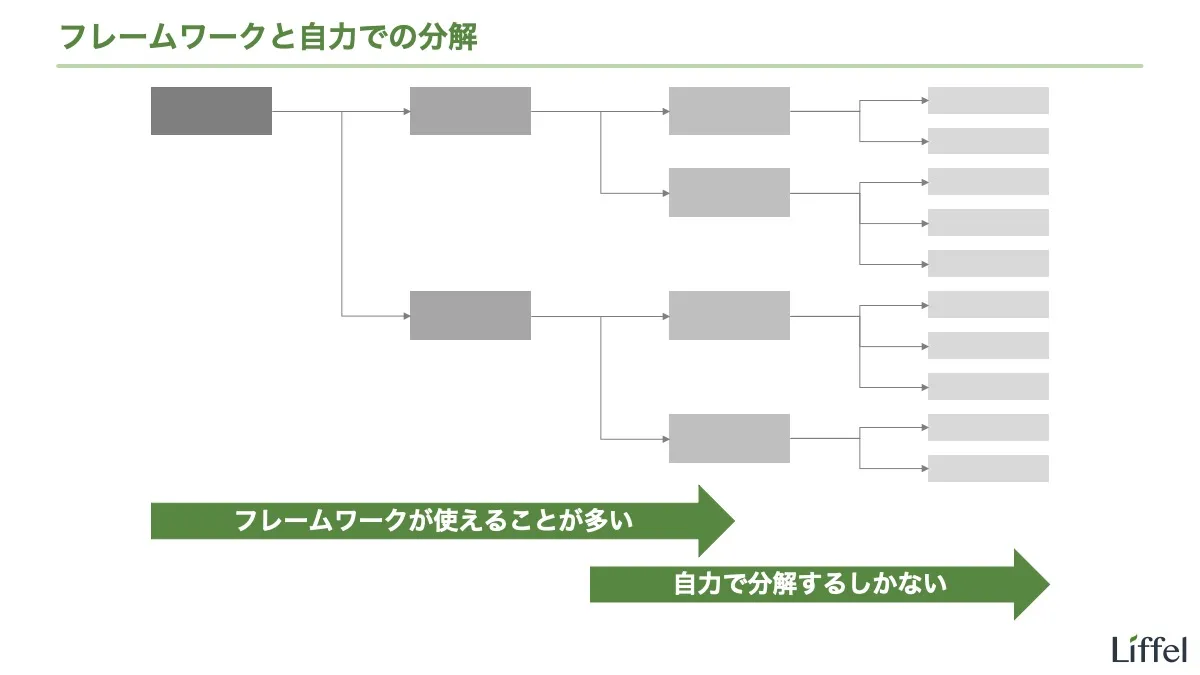
When frameworks alone can’t take you deep enough, you have to do it on your own
So in the end, you need to be able to do both. Be careful, since frameworks won’t solve everything.
Still, Frameworks First
As you’ve seen, frameworks come with some cautions. But these don’t cancel out the advantage of frameworks: “you can make right breakdowns without spending time.”
Put simply, there’s no reason not to use a framework for a question it applies to. You can make right breakdowns without spending time, after all. Of course, judging whether a framework applies is the hard part, but if you get it wrong, you can just redo it.
That covers frameworks in critical thinking. Next time, I’ll show you how to spot useless frameworks.
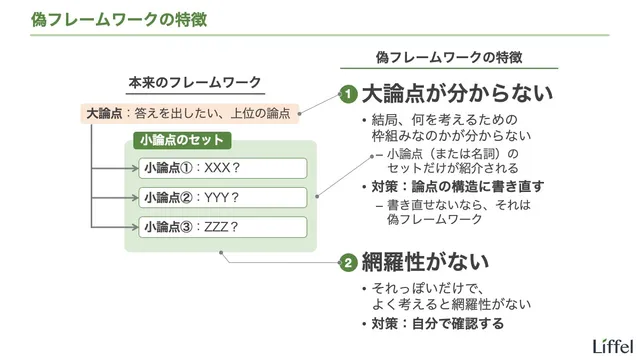
Entries related to critical thinking are collected on the page below. Feel free to use them as a reference.
Footnotes
-
For example, I can say for certain that the framework “Effort = Quality (how you make the effort) × Quantity (time invested)” is exhaustive. Since it simply divides “effort” by “time” and multiplies it back, it’s mathematically clear that nothing is missing. ↩
-
Special illnesses and the like may be exceptions. ↩
-
However, for sports, you might count things like compatibility with your coach or the team’s tactics as luck. For studying, too, a one-shot exam such as an entrance exam brings in an element of luck: how well the exam questions suit you. ↩
-
Of course, doing so sacrifices the exhaustiveness of your premises. But outside academia, deciding on a solution and taking action normally takes priority over strict rightness of premises. ↩