In this entry, let’s think about how to break down the question, and how to learn to do it.
This entry is a sequel to the one below. Read it first.

Let’s begin.
toc
Why Breaking Down the Question Matters
Let me emphasize this first: breaking down the question is the key point in learning critical thinking. There are two reasons:
- It’s essential to successful critical thinking
- It’s hard to master
Let me explain each in turn.
Why It Matters 1: It’s Essential to Successful Critical Thinking
First, unless you can break down the question the right way, critical thinking won’t succeed. Let’s briefly review.
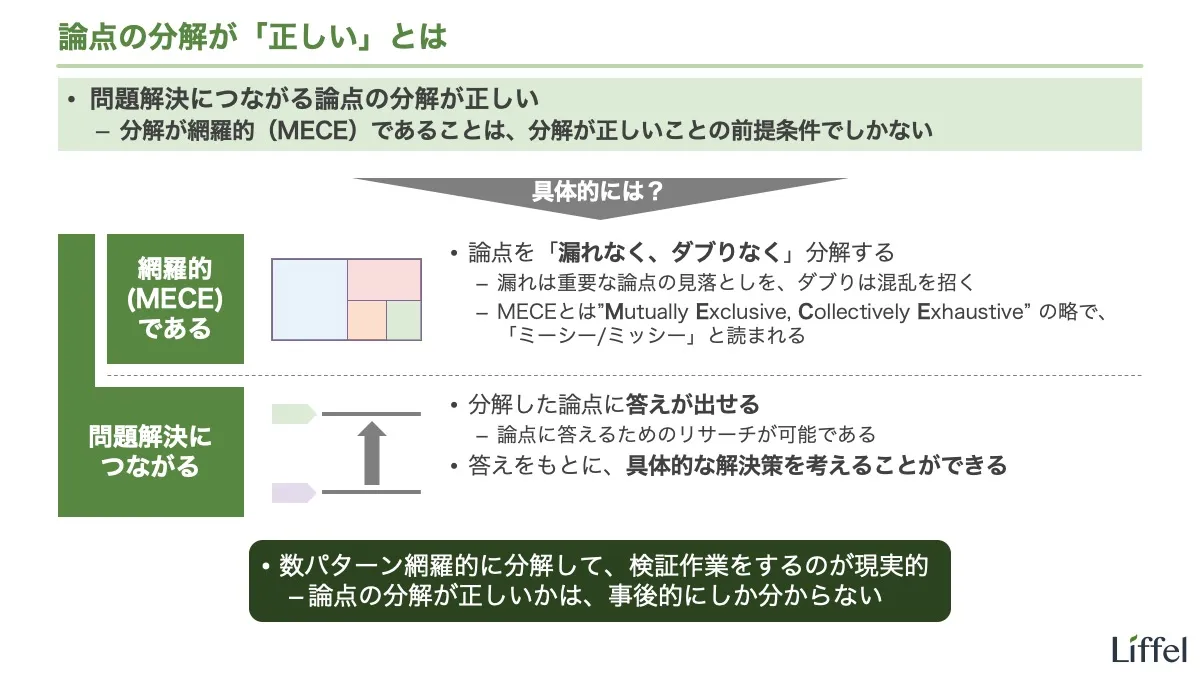
If you can’t break down the question exhaustively, the premises lose their exhaustiveness. As a result, the premises lose their validity, and the claim won’t be accepted as right1.
And even if you break it down exhaustively, if the breakdown doesn’t lead to problem solving, you can’t achieve the ultimate goal of solving the problem.
In this way, being able to break down the question exhaustively, and in a way that leads to problem solving, is essential to successful critical thinking.
Why It Matters 2: It’s Hard to Master
This is the real problem: you won’t suddenly get good at breaking down the question. That was true for me, and in my teaching experience, I’ve never seen anyone suddenly improve dramatically at this skill. Although it’s an important skill, it’s hard to master.
Frankly, breaking down the question the right way isn’t the most important point in critical thinking. As I’ve explained in the entries below, making the question clear and ensuring the objectivity of premises are more important.
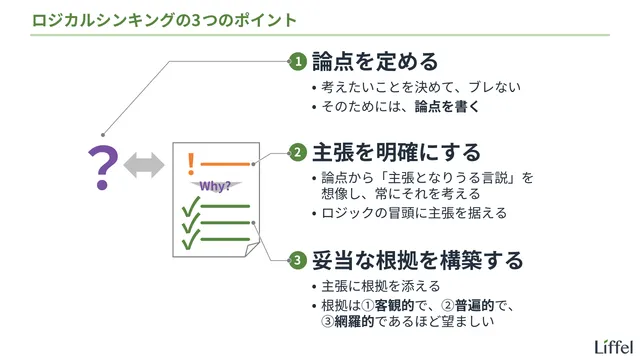
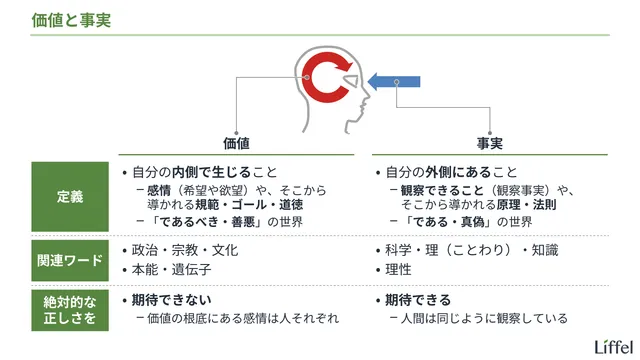
But these points are more knowledge than skill. For example, although making the question clear is the most important point of critical thinking, you can handle it just by “writing the question down and making it specific.” As for the objectivity of premises, what’s needed most is a vow “not to lie.” That’s not even knowledge.
Breaking down the question, on the other hand, is purely a skill. You’ll never acquire it unless you repeat it many times yourself. What’s more, since “what premises are exhaustive is decided subjectively,” there’s the added bonus that you can’t say in general what the right breakdown is for any given question.
In other words, this is where people pull ahead. Even for important things, if there’s a set way to do them, people don’t differ much. But there’s no such set way for breaking down the question. As a result, individual differences inevitably show up here. You have no choice but to repeat breakdowns again and again and find your own way.
How to Break Down the Question
So how should you learn to break down the question, given how important it is?
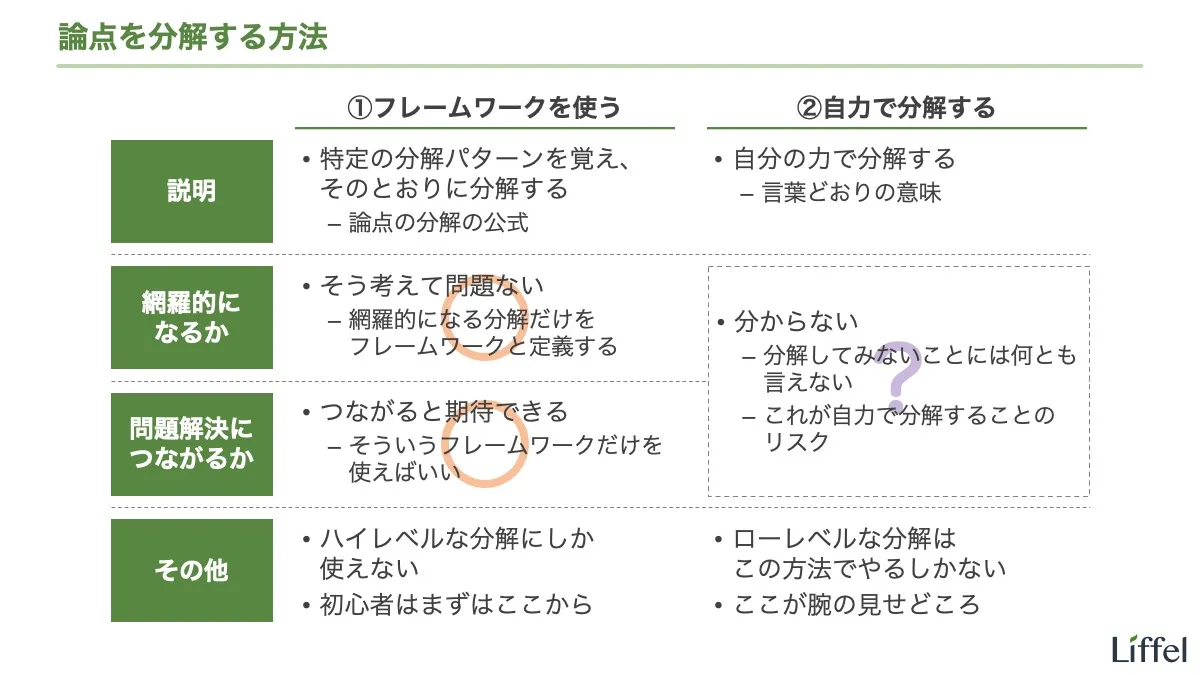
First, understand the approaches to breaking down the question. The slide below summarizes them.
As shown, there are broadly two ways to break down the question (both explained in detail in later entries):
- Use a framework
- Break it down on your own
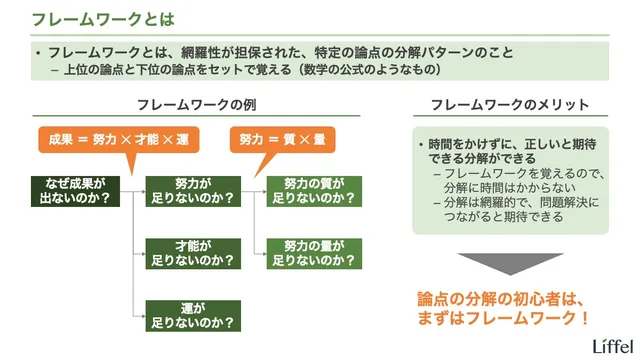
Of these, “(1) a framework” is a specific pattern of breakdown. Like a math formula, you memorize “when this type of question comes up, break it down this way.”
I’ll explain frameworks in detail starting from the next entry. In short, frameworks let you make right breakdowns easily.
“(2) Breaking it down on your own,” on the other hand, means just what it says. It’s a no-holds-barred approach. You don’t do anything special.
In other words, there are only two ways to break down the question: use a framework or don’t.
Frameworks First
Which should you use? To give the conclusion, use frameworks to break down the question whenever possible. You should absolutely do so, especially until you get used to breaking down questions.
The reason is simple: using the right framework in the right situation has no downside. It has only upsides. Obviously, frameworks have spread because they’re handy to use. There’s no reason not to use them when you can.
Of course, “using the right framework in the right situation” isn’t straightforward. I’ll explain how to handle that in later entries. There’s no need to worry too much.
While you’re new to critical thinking, it’s crucial to understand through experience, via frameworks, “why breaking down the question the right way matters.” Since I’ll introduce many frameworks in later entries, start by keeping these two things in mind:
- Memorize frameworks
- Actually try using them
That covers how to learn to break down the question. From the next entry, let’s start learning frameworks.
Entries related to critical thinking are collected on the page below. Feel free to use them as a reference.